How to Use an Anion Gap Calculator in Hypoproteinemia
What Anion Gap Measurement Shows
The anion gap is a practical way to assess the relationship between serum electrolytes that are routinely measured and those that are not directly reported. It supports clinicians determine whether an acid-base disorder is present, especially when the pattern on a basic chemistry panel points to metabolic acidosis. An anion gap calculator organizes the input values and speeds up this comparison, but the meaning of the result depends on the overall clinical picture.
At its core, the anion gap reflects the separation between major measured cations and measured anions in the blood. Because sodium, chloride, and bicarbonate are usually available on an electrolyte panel, the calculator can rapidly estimate whether there are extra unmeasured anions contributing to an acid-base assessment. That makes it valuable for interpreting laboratory values in patients with suspected metabolic derangement.
The value is not a diagnosis by itself. Instead, it is a diagnostic tool that supports clinical interpretation of acid-base patterns. A widened gap often points to retained acids or toxins, while a normal result may suggest a different mechanism. Understanding the underlying physiology helps prevent overcalling or missing disease.
Why Hypoproteinemia Changes the Anion Gap
Hypoproteinemia alters the anion gap because blood proteins, especially albumin, contribute negative charge in plasma. Since albumin is one of the main unmeasured anions, low protein levels can make the anion gap appear lower than it truly is. This is one reason the raw number can be misleading in patients with hypoalbuminemia.
Serum albumin functions as a buffer for electrical neutrality. When the albumin level drops, the body compensates by redistributing other ions, often increasing chloride to preserve charge balance. That shift can mask a clinically significant acid load. In other words, a patient with low protein levels may have an acid-base problem that is hidden by the altered baseline.
This matters because the gap is often used to identify excess acids in metabolic acidosis. If albumin is low, the measured gap can underestimate the true presence of retained acids. The result may look less concerning than the actual clinical context warrants.
For that reason, clinicians should think of hypoproteinemia as a source of deviation from the expected reference range. The goal is not just to calculate the number, but to interpret what the number means after accounting for protein levels. That is where albumin-aware analysis becomes essential.
In what way Anion Gap Calculator Functions
The anion gap calculator uses the usual computational formula using commonly reported serum electrolytes. The most widely used approach is:
Anion gap = sodium - (chloride + bicarbonate)
In this case, sodium is the recorded cation, and chloride plus bicarbonate represent the main measured anions. The calculator deducts the sum of the anions from sodium to estimate the concentration of unmeasured ions.
The value of the calculation comes from its fastness and uniformity. Rather than manually comparing values each time, the calculator allows the clinician plug in the laboratory values and immediately assess whether the result is within the expected reference range. It also supports comparison across serial lab results when monitoring a patient over time.
Various laboratories may use slightly different methods or reporting conventions, so interpretation should always reflect the specific panel and local threshold. Even when the formula is simple, the meaning of the output depends on the surrounding electrolyte imbalance and the patient’s symptoms.
Albumin Adjusted Anion Gap
The biggest practical issue in hypoproteinemia is deciding when to apply albumin correction. Since albumin accounts for much of the unmeasured negative charge, low protein levels can decrease the measured value even if the underlying acid burden is substantial. A corrected anion gap adjusts for the reduced serum albumin so the result more closely matches the true acid-base state.
Several correction methods exist, but the underlying principle is the same: correct for albumin before concluding that the anion gap is normal. A common approach applies a set amount for every decrease in albumin below a standard value. The exact formula may vary by institution, but the clinical goal is to avoid downplaying metabolic acidosis.
Why is this important? Because the raw gap may suggest a normal result when there is actually a hidden high anion gap metabolic acidosis. Albumin correction improves diagnostic accuracy by factoring in protein-related changes in plasma charge balance. This is especially important when evaluating a patient with low protein levels and an otherwise confusing chemistry profile.
View the corrected result as a more realistic comparison against the expected baseline. The raw number gives one clue, but the corrected number gives a better estimate of whether there are excess acids or other unmeasured anions affecting the chemistry pattern.
Ordered Interpretation in Hypoproteinemia
Interpreting the result starts with the raw anion gap, then moves to albumin-aware adjustment, and finally to the broader overall assessment. A structured workflow serves to help prevent missed disease and improves better clinical interpretation.
- Step 1: Examine the serum electrolytes on the electrolyte panel: sodium, chloride, and bicarbonate.
- Step 2: Run the anion gap calculator and follow the calculation formula.
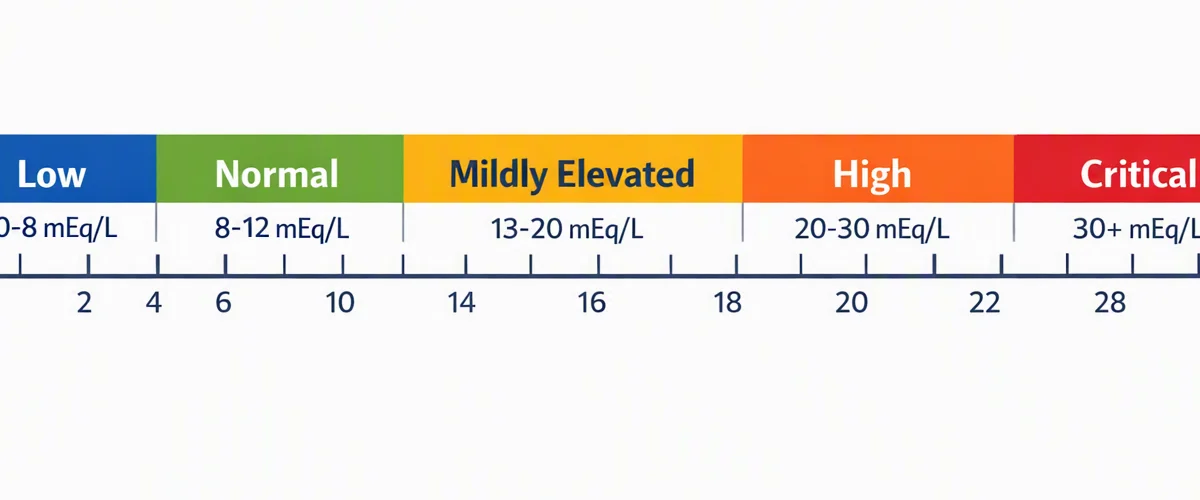
- Step 3: Check whether the result sits in the expected reference range.
- Step 4: Evaluate serum albumin and determine whether albumin correction is needed.
- Step 5: Contrast the raw result with the corrected anion gap.
- Step 6: Interpret the finding in the context of blood gas data, symptoms, and other laboratory values.
If the raw value is within range but albumin is low, do not end there. A patient may still have a high anion gap after correction. That can suggest hidden acid accumulation even when the initial result looks reassuring.
If the corrected value remains normal, the pattern may fit a normal anion gap metabolic acidosis, depending on bicarbonate, chloride, and the rest of the picture. This distinction is important because different acid-base disorders require different evaluation and treatment strategies.
In practice, the anion gap should always be read alongside the patient’s symptoms, medications, kidney function, and oxygenation status. The calculator assists organize the data, but it does not replace reasoning about the cause of the acid-base disorder.
Frequent Reasons of a Deceptive Anion Gap
Several issues can skew the apparent gap and cause a wrong interpretation. One typical https://jsbin.com/nuhofadota problem is lab error. Handling of samples, recording errors, or specimen contamination can all alter the measured values and change the final calculation.
Hypoalbuminemia is yet another major reason of a misleading result. When albumin is low, the measured gap may appear normal even if the patient has a clinically important acid load. This is why albumin correction is so important in patients with hypoproteinemia.
Electrolyte imbalance can also make the result less straightforward. Changes in sodium, chloride, or bicarbonate may suggest volume status, medications, or comorbid illness. The calculator can identify a mathematical difference, but only careful interpretation can explain why it happened.
Additional factors include changes in unmeasured ions, dilutional states, or mixed disorders that blur the expected pattern. Because these situations can overlap, the anion gap should be treated as one component of a broader clinical workup rather than a standalone answer.
Patient-care Cases Where Calibration Counts
Albumin correction plays a role mainly when a clinician is seeking to miss failing to detect a serious acid load. That is most relevant in metabolic acidosis, where the anion gap helps separate causes driven by excess acids from those driven by bicarbonate loss.
In renal failure, the body may retain acids that increase the anion gap. If the patient also has hypoproteinemia, the raw number can underestimate the severity of the disorder. A corrected calculation helps uncover the hidden burden more accurately.
Lactic acidosis is a further high-stakes example. Lactate accumulation adds unmeasured acid and can lead to a substantial high anion gap metabolic acidosis. If hypoalbuminemia is present, the raw gap may not fully capture the severity of the lactate-driven disturbance.
Ketoacidosis also frequently raises the anion gap. In that setting, correction can help estimate whether the acid burden is more severe than it first appears, particularly if low protein levels coexist with dehydration, poor nutrition, or chronic illness. The corrected result helps align the chemistry pattern with the patient’s actual risk.
These scenarios show why albumin-aware interpretation is not an academic detail. It can alter the impression from borderline to clearly abnormal, which may influence diagnosis, monitoring, and treatment decisions.
Constraints of Anion Gap Calculators
Even a well-designed calculator has limits. The first is the reference range. Various labs may use different approaches, instruments, or reporting standards, so the same patient may receive slightly different interpretations depending on where the sample is analyzed.
Another limitation is that a blood gas may show a pH or bicarbonate pattern that does not perfectly align with the chemistry panel. This can happen because the blood gas and serum chemistry are not always drawn at exactly the same time, or because the patient has a mixed disorder. The calculator can assist, but it cannot eliminate every discrepancy.
Clinical judgment remains essential. The calculator gives structure, but interpretation still depends on symptoms, physical exam findings, medications, kidney function, and the overall clinical context. A numeric result should be treated as a clue, not a conclusion.
It is also important to remember that the anion gap does not identify every cause of metabolic derangement. Some patients have a meaningful disorder with a normal gap, while others have a mildly elevated gap that is not clinically significant. The best approach is to integrate the calculator output with the broader acid-base assessment.
FAQ: Anion Gap Calculator and Hypoproteinemia
What is an anion gap calculator used for in hypoproteinemia?
An anion gap calculator is used to estimate the difference between measured cations and anions and then interpret that result in the setting of low protein levels. In hypoproteinemia, it helps clinicians decide whether the raw result needs albumin correction so that hidden acid-base problems are not overlooked.
How does low albumin affect the anion gap?
Low albumin lowers the amount of negatively charged unmeasured anions in the blood. That can make the anion gap appear falsely low or normal, even when there is an underlying acid load. This is why hypoalbuminemia can mask clinically important metabolic acidosis.
What is the equation for correcting the anion gap for albumin?
The exact anion gap formula for albumin adjustment can differ by institution, but the purpose is to modify the raw value based on the patient’s serum albumin. Many clinicians follow a standard correction that includes a set amount for every decrease in albumin below the normal level. Always use local practice when determining the corrected anion gap.
Can a normal anion gap still hide a serious acid-base disorder?
Indeed. A normal result can still hide a serious acid-base disorder, especially if serum albumin is low. In that setting, the raw number may look reassuring even though the corrected value would show a high anion gap. That is why albumin-sensitive interpretation is important for accurate diagnostic accuracy.
When should a corrected anion gap be used instead of the raw result?
A corrected anion gap should be used whenever protein deficiency or low albumin is present and the clinician is evaluating possible metabolic acidosis. It is especially important in renal failure, lactic acidosis, and ketoacidosis, where missing an elevated acid burden could alter management. The corrected value gives a clearer estimate of the true acid-base status than the raw result alone.